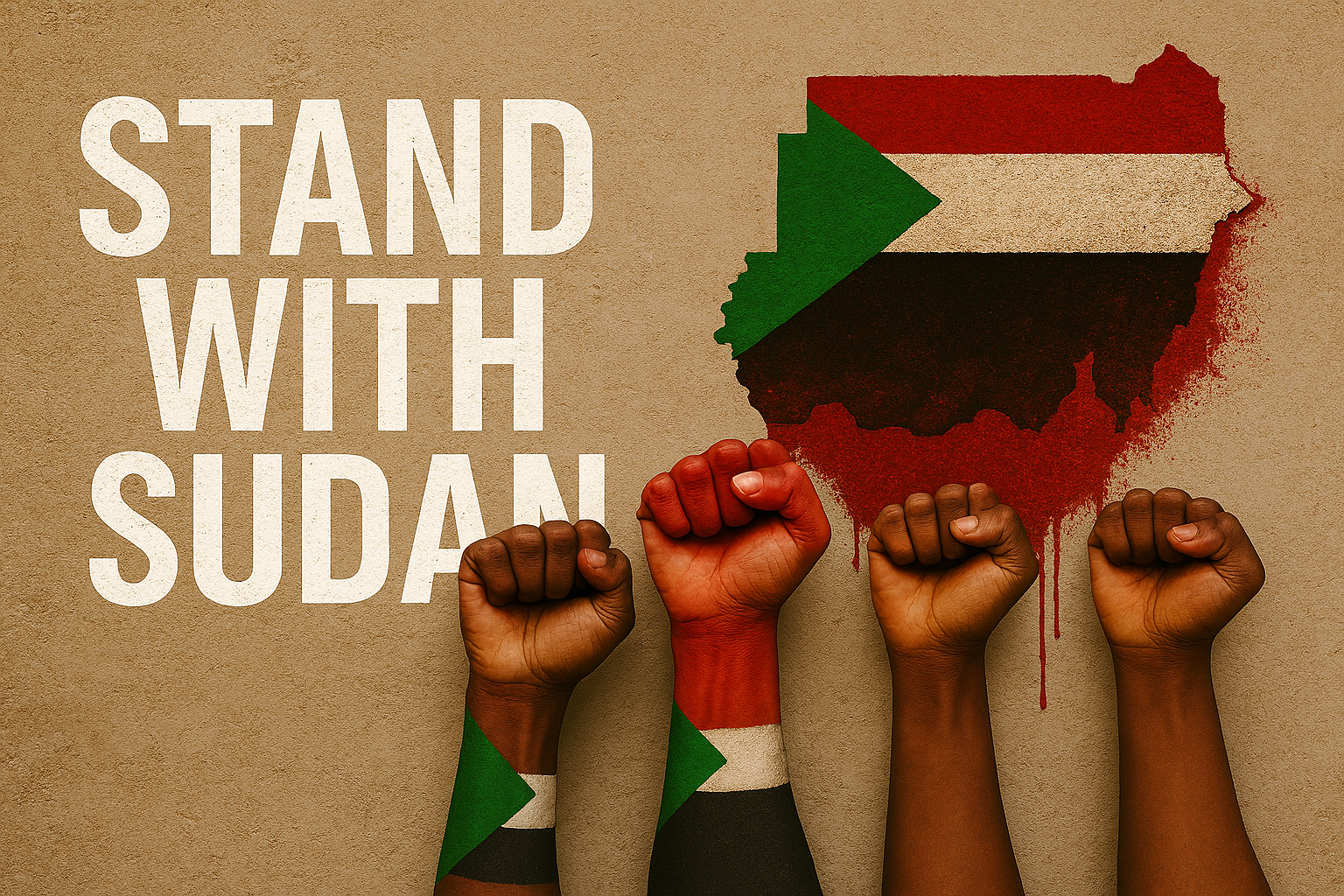
The fall of El Fasher — the capital of North Darfur and the last remaining stronghold of the Sudanese Armed Forces (SAF) in the region — marks a terrifying new chapter in Sudan’s counter-revolutionary war. Once a proud centre of community, trade, and resistance, the city’s capture by the Rapid Support Forces (RSF) militia in late October 2025, after more than 18 months under siege, has unleashed unspeakable suffering.
Eyewitnesses and human rights groups have documented atrocities on a massive scale — ethnic cleansing, mass executions, food and medical aid blockades, rape and sexual violence, and the deliberate targeting of civilians as they fled for safety.
What is happening in El Fasher is not an isolated tragedy. It is the latest, bloodiest episode in a war between two rival militias: the SAF, dominated by remnants of the old Muslim Brotherhood regime with a long history of state violence and genocide, and the RSF, a paramilitary force that grew out of the Janjaweed militias responsible for the Darfur genocide in the 2000s. Both forces were born from the same repressive state that the 2018 revolution sought to overthrow.
Since fighting erupted in April 2023, hundreds of thousands have been murdered and over 15 million people forced from their homes — creating the world’s largest humanitarian crisis today.
Detailed Report
The Revolution Deflected
The current war is a direct consequence of the counter-revolution waged against the 2018 Sudanese Revolution. Millions took to the streets in a mass, non-violent uprising, organised through neighbourhood Resistance Committees (RCs), Sudanese Professional Association (SPA), Forces of Freedom and Change (FFC) —an umbrella of established opposition parties— and women and students’ organisations to overthrow the 30-year dictatorship of Omar al-Bashir. The revolution’s slogans—”Freedom, Peace, and Justice“—were a rejection of decades of military rule, capitalist exploitation, inequality, and state-sponsored violence.
However, the revolution’s greatest strength—its spontaneity and grassroots energy—was also its deepest vulnerability. It lacked an organised, independent revolutionary party capable of leading the masses to seize power and dismantle the state apparatus and structures of the old regime. In the absence of such leadership, the FFC, under pressure from regional powers and Western governments, surrendered the revolution’s gains. The 2019 power-sharing deal with the generals of the old order did not mark a step toward democracy—it was a strategic retreat that legitimised the military junta and kept the capitalist and security apparatus intact. It placed the two military architects of the counter-revolution — General Abdel Fattah al-Burhan of the Sudanese Armed Forces (SAF) and General Mohamed Hamdan Dagalo (“Hemedti”) of the Rapid Support Forces (RSF) — at the centre of the new order.
Together, they murdered and tortured tens of thousands of revolutionaries, carried out the June 3, 2019 massacres at 14 sit-ins where thousands were slaughtered, and later orchestrated the October 2021 coup that dissolved the transitional government and abducted the civilian ministers and revolutionary forces.
The war that erupted in April 2023 was the inevitable consequence of this failed compromise—a violent clash between two rival militias of the same regime, each fighting to control the state and its wealth. What we are witnessing today is not the collapse of Sudan’s revolution, but the bankruptcy of the counter-revolutionary forces that sought to kill it.
El Fasher: A Human Tragedy
El Fasher’s fall on October 27, 2025, came after an 18-month siege and following the SAF’s agreement to allow RSF forces to return from other regions, including Khartoum, a few months earlier. This represents a catastrophic escalation in Sudan’s ongoing war.
Reports from the ground paint a picture of unimaginable horror:
- Mass Killings: At least 1,500 to 2,000 civilians were killed in the first few days of the RSF takeover as they tried to flee.
- Hospital Massacres: In a heinous war crime, RSF fighters stormed the Saudi Maternity Hospital and “cold-bloodedly killed everyone they found inside”, including patients, their companions, and medical staff. The World Health Organisation reported that 460 people were killed in this single attack.
- Ethnic Cleansing: The violence has been marked by a deliberate and systematic campaign of killing and extermination, targeting non-Arab ethnic groups like the Zaghawa and Masalit, echoing the atrocities of 20 years ago.
- Widespread Atrocities: Survivors report summary executions, house-to-house raids, rampant sexual violence and rape against women and girls, and the murder of fleeing civilians. Videos have surfaced showing RSF fighters executing unarmed men.
In a statement, the Sudanese Doctors’ Union – UK condemned the events in El Fasher as:
“amounting to war crimes and crimes against humanity” and warned that “These actions pose the threat of an imminent and large-scale humanitarian catastrophe.”
The SAF, for its part, announced a retreat — just as it did in other cities like Madani and Sinja — citing the RSF’s mass killings of civilians. In reality, this was not a tactical failure but a calculated political decision. The SAF chose to abandon El Fasher’s remaining 250,000 residents to their fate, trading lives for political survival. By letting RSF forces withdraw unchallenged from other fronts, the SAF willingly sacrificed Darfur and its people to consolidate control over Khartoum and the region, and to protect SAF’s own power — proving once again that both militias serve only the interests of the ruling class, not the people of Sudan.
The Sudan resistance committees and forces signatories to the Revolutionary Charter for Establishing People’s Authority laid out a clear dual accountability:
We hold the Rapid Support Forces (RSF)—the Janjaweed militia—and their allies… regional and international forces supporting them, led by the United Arab Emirates, fully responsible for these massacres, violations, killings, looting and all war crimes and crimes against humanity that rise to the level of genocide.
Crucially, they reserved equally sharp condemnation for the army’s role in the betrayal of civilians:
We also hold the army leadership… accountable for abandoning their duty to protect unarmed civilians, leaving them to face the fascism of the Janjaweed militia alone. Their actions—mobilising forces, escalating the war… and forcing civilians to bear the cost of these decisions—have become a persistent and deliberate pattern.
The grim reality is that what is happening in the Darfur region is not a sudden tragedy but a continuation of many decades of crimes committed by Sudan’s military rule across Sudan on different levels and stages; it is the product of political and economic neglect, resource competition, and state-sponsored and proxy violence that stretches back decades.
Global Imperialism and the Threat of Partition
The war in Sudan is not simply a domestic conflict between two armed factions — it is a crisis fueled and exacerbated by the greed and strategic interests of global and regional powers. What began as a struggle between rival militias has evolved into a proxy war, with imperialist states and neighboring regimes vying for control over Sudan’s gold, natural resources, fertile land, and its critical position along the Red Sea.
| Faction | Foreign Backers | Interests |
| Rapid Support Forces (RSF) | United Arab Emirates (UAE): The primary backer, providing advanced weaponry (including Chinese-made drones), financial support, and logistical routes. Russia: The Wagner Group provides military support in exchange for access to Sudan’s lucrative gold mines. Libya (Haftar) & Chad: Serve as logistical hubs and conduits for arms and fighters. | Control of gold mines, agricultural land, and strategic access to the Red Sea and Sahel. |
| Sudanese Armed Forces (SAF) | Egypt: Provides military and political support to secure its southern border and influence over Nile water resources. Turkey: Supplied Bayraktar TB2 drones, bolstering the SAF’s air power. Iran & Saudi Arabia: Provide varying degrees of military and financial support to counter rivals and secure regional influence. | Maintaining the traditional military establishment’s grip on the state and economy, and control of resources and land, and securing control over land and strategic resources. |
While many states are entangled in arming or funding one or both sides, the table above highlights only the key actors directly sustaining this bloodshed.
The US and European governments issue their ritual condemnations of “both sides”, yet they continue to back these same militias through their regional allies and agents. Weapons and money flow freely from Gulf monarchies and neighbouring regimes, ensuring the war machine is constantly replenished. The same governments that financed and helped build the RSF under the so-called Khartoum Process—in exchange for Europe’s border security— and sought to stop the revolution since its start in 2018, now posture as neutral arbiters of peace. Their real concern is not the suffering of Sudanese people, but the preservation of a regional order that protects profits, trade routes, and the plunder of resources.
This is imperialism in its modern form — not the direct colonial rule of the past, but domination through clients, contracts, and chaos. The world powers no longer need to plant their flags; they maintain control by financing those who will protect their interests, no matter the human cost.
This international meddling has not only prolonged the war but is actively driving the country towards disintegration. The fall of El Fasher gives the RSF near-total control of the vast Darfur region, which is nearly the size of France. The RSF has already established a parallel “Government of Peace and Unity” to administer its territories from Darfur, while the SAF-led government operates from Port Sudan on the Red Sea. Neither of these so-called governments has any legitimacy or popular support. This de facto partition, splitting the country along an east-west divide, is a scenario that some regional actors now see as an acceptable outcome, mirroring the division of Libya. Meanwhile, both militias continue to create and arm new forces, accelerating Sudan’s fragmentation and tearing society apart, transforming the war into a sprawling civil conflict that threatens not only Sudan but the entire region. By mid-2024, the eastern states alone already hosted at least 22 militias in addition to the SAF and RSF forces — a number that has only grown as the war intensifies and remnants of the old regime call for public mobilisation. Militarisation now dominates everyday life in Sudan, leaving ordinary people to bear the heaviest cost of a war driven by power, profit, and foreign greed.
📢 Upcoming: MENA Solidarity Arms Flow Report
MENA Solidarity will soon publish a detailed report tracing the global arms flows into Sudan — exposing the states, corporations, and financial networks fuelling this war.
⚠️Important Note: Rejecting Both Militias and Exposing Global Complicity
We must reject the false choice between the SAF and RSF militias and the propaganda that seeks to legitimise either side. As MENA Solidarity’s analysis asserts, both are enemies of the people’s 2018 revolution, equally criminal, and obstacles to revolutionary change.
It is also crucial not to focus solely on condemning one war backer, such as the United Arab Emirates (UAE), despite its leading role in arming, funding, and sustaining the RSF’s war machine. Doing so risks obscuring the broader web of complicity, as the UAE operates within a global imperial network where Western powers, Gulf monarchies, and regional regimes all share responsibility for Sudan’s destruction. Singling out one state allows others to hide behind empty statements of “concern” while continuing to profit from the war. Our task is to expose and confront the entire system that enables counter-revolution and imperial plunder, not just one of its visible faces.
A Call for International Solidarity
The tragedy of Sudan is a stark lesson in the dynamics of revolution, counter-revolution, and imperialism. The world has failed the people of Sudan, offering apathy and resignation in the face of destruction and mass murder. The solution to this crisis will not come from backing one militia against the other, nor from the failed diplomatic initiatives of the same powers fueling the war.
As trade-unionists, socialists, and all who believe in justice, our response must be grounded in the class-based, internationalist politics that shaped the 2018 revolution. That means:
- Demanding our governments end all arms sales and support to the warring militias and their regional backers.
- Campaigning to expose the role of corporations and states profiting from Sudan’s war and plundering its resources.
- Providing direct financial and political support to the Sudanese Doctors Union in the UK.
- Amplifying the voices of Sudanese workers, professional associations, women’s organisations, emergency response rooms, and resistance committees who demand civilian rule, accountability, and the dismantling of militias—not hollow technocratic settlements that leave the military and security apparatus untouched.
- Building coordinated international labour solidarity: solidarity pickets, union motions, parliamentary questions, fundraising for mutual aid and direct support for Sudanese civil society groups documenting abuses.
- Connecting the struggle of Sudanese workers and revolutionaries to our own fights against war, austerity, and racism at home.
Take action:
- Access our Stop the War in Sudan toolkit and sign the postcard addressed to Prime Minister Keir Starmer, urging the British government to support the Sudanese people.
- Share this motion with your union branch and advocate for its adoption: Model Motion – Stand with Sudan: Stop the War, Support the People
- Read our analysis, “The Illusion of Choice: Why People Should Reject Both Sides of the War in Sudan”, for essential background on the warring factions and the revolutionary alternative.
- Download / order our newly released “Sudan’s Revolutionary and Popular Movements: a research report”.
- Book your ticket for the new film “Sudan, remember us” at a screening near you.
Download resources:
- Sudan Update July 2025 – download the leaflet >>here
- ‘Sudan’s Militia War on the People’ Sudan Update April 2025 – download the leaflet >>here
- ‘Reject both sides in Sudan’s war’ Sudan Update February 2025 – download the leaflet >>here
- ‘Famine is the new war’ Sudan Update September 2024 – download the leaflet >>here
- ‘Stopping Sudan’s hidden war’ Sudan Update March 2024 – download the leaflet >>here
- ‘Why is there a war in Sudan?’ Sudan Update May 2023 – download the leaflet >>here
- ‘Stop the war in Sudan’ Sudan Update April 2023 – download the leaflet >>here
- Stop the war in Sudan / Refugees welcome A4 poster – download >>here
 MENA Solidarity Network
Pingback: Solidaarisuusverkosto: Mitä Al-Faširin kukistuminen tarkoittaa – Työväen antimilitaristit
Pingback: Eyes on Sudan! – South London socialist
Pingback: De val van Al-Fashir - Wat het ons vertelt over de oorlog in Soedan, de revolutie en de strijd voor solidariteit | Doorbraak.eu
Pingback: Sudan: Der Fall von El Fasher und seine Hintergründe
Pingback: Free Abo Bakr Hamza: The Lawyer Who Dared to Help in Sudan’s War | MENA Solidarity Network
Pingback: Der Fall von El Fasher und seine Hintergründe » InterSoZ.Org
Pingback: Event: Sudan Solidarity Conference 2026 | MENA Solidarity Network
Pingback: 2025 in Review: Voices of Resistance Across MENA and Beyond | MENA Solidarity Network