
A wave of demonstrations rocked the city of Sweida in southern Syria between August and September 2023. Thousands took to the streets on a weekly basis after the government removed fuel subsidies, chanting against the Assad regime. Abdulsalam Dallal analyses the background to this new revolt.
This is an article from the current issue of Middle East Solidarity magazine. Download the full issue here, or order your print copy from Bookmarks Bookshop.
The Syrian Revolution, which began in 2011 as a peaceful movement for reform and freedom from the authoritarian rule of the al-Asad family, has undergone a tragic transformation over the past twelve years.
The peaceful movement evolved into a devastating civil war marked by brutality and chaos, attracting regional and international actors, whose intervention complicated the scene and made Syrians’ dream of freedom and democracy a far-off goal.
Despite the lack of international and Arabic coverage for the unfolding events in Syria, particularly in Sweida (Al-Suwayda), the predominantly Druze province nestled in southern Syria has indeed become a symbol of resilience and resistance, reviving Syrians’ hope of having a political change. In this time of despair for Syrians, the extraordinary developments within Sweida, have brought back the early days of the peaceful protests. The protests also prove their exceptional resolve in the face of adversity and their steadfast defiance against the oppressive regime of Bashar al-Asad.
Politicians, academics, scholars, and commentators tend to understand Syria through the realm of realpolitik, accepting that there will be no regime change in Syria. The worst humanitarian crisis since the Second World War is not on the news anymore. This shift in tactics has had profound implications not only for Syrians but for the entire region. The scale of destruction and the level of losses, and later the normalization of the Asad regime by the Arab countries was a harsh lesson not only for Syrians but also for the youth in the Arab world. Given these gloomy circumstances, the governorate of Sweida has a different word to say. Indeed, the recent protests in Sweida have turned Syria into a crucible of resilience.
Sweida governorate, strategically positioned in southern Syria near the cradle of the Revolution, Dara’a, has been always under the radar of the Asad regime. Populated by the Druze sect, the Asad regime tried every means to isolate it from the unfolding events in other governorates over the past twelve years.
Until 20 August 2023, all the previous protests which took place in the governorate were either accommodated by the Asad regime policies or response to the threat of the Islamic State group. What has been going on in Sweida since this August symbolises a beacon of hope for Syrians yearning for change and serves as a resolute counterpoint to the Asad regime.
The current resistance in Sweida evokes poignant echoes of the region’s historical defiance against foreign rule. The Druze always resisted the colonisers, including the French Mandate imposed after World War One, through their prominent leader, Sultan al-Atrash, who led the Great Syrian Revolt in 1925. What makes the current demonstrations in Sweida special is not only the demand for the application of United Nations Security Council Resolution 2254, which entails a political transformation in Syria but also the support of the Shuyoukh al-Aql, the spiritual religious leaders of the Druze sect, who have endorsed people’s demands.
The Druze consider Shuyoukh al-Aql as their reference for guidance at religious and social levels. Although the spiritual leaders claim that they do not have any political roles, they in practice influence the public at the social, political and religious levels. These leaders have played a pivotal role in preserving the region’s unity. Notable individuals such as Sheikhs Hikmat al-Hajari and Hammoud al-Hinnawi have emerged as central figures in Sweida’s current demonstrations. Their roles and actions are indicative of the evolving dynamics within the province, as they navigate the delicate balance between traditional and contemporary challenges. They, on many occasions, voiced their support for the demands of demonstrators and because of them, the demonstrations of Sweida gained momentum.
Observers, analysts, and journalists tend to connect what is happening in Sweida primarily to the rise in the cost of living. However, Sweida’s discontent with the Asad regime is deeply rooted in the deteriorating political, security and economic policies adopted by the regime. Bashar al-Asad’s Legislative Decree No. 11 was the spark for the protests. The decree stipulates a 100 percent increase in salaries and wages for workers in the state and the public sector.
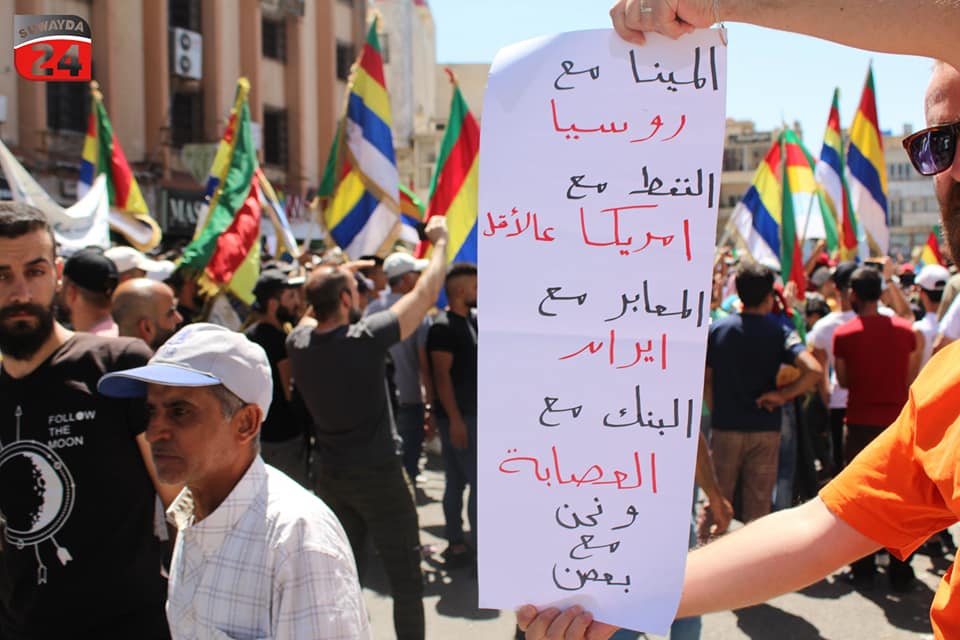
The regime’s government approved the decree in return for the total elimination of subsidies from fuel, which eventually led to an increase in the fuel prices of 140 percent, aggravating the decline in living standards for Syrians, who are also suffering extortion by the army and security apparatus, leaving them disillusioned with the regime’s ability to govern. The Asad regime’s close associations with Iranian companies and Hezbollah have ignited significant concerns among Syrians, including those in Sweida. Many perceive these alliances as detrimental to their interests and sovereignty, further eroding trust in the regime. Asad’s authoritarian rule has cultivated a prevailing perception that he regards Syria as his fiefdom, fostering increasing resentment among the Syrian people. This perception has fueled the desire for political change. Asad’s opponents believe that Bashar al-Asad began selling Syria’s natural resources such as the phosphate reservoir in Homs and the harbours at the coasts through long-term contracts.
Chants about people in Sweida not wanting a president who treats Syria as his property, and signing long-term contracts with Iran and Russia to pay back the price for helping him stay in power, were clear in the demonstrations.
Syrians, especially those residing in areas under Asad’s control, have witnessed firsthand the regime’s prioritisation of its loyalists over the well-being of others. This erosion of trust has galvanised demonstrations in Sweida and beyond. This comes after the regime failed to respond to an initiative by Arab governments which suggested that Asad should release political prisoners, unveil the fate of the missing, create a safe environment for the return of the refugees, curtail the manufacturing and export of drugs such as Captagon, a highly addictive form of amphetamine, and eventually apply UN Security Council Resolution 2254 which will lead to a political transformation in Syria.
This approach is known as the Khitwa bi Khitwa (a step-by-step) agreement with the Arab countries and these countries in return will facilitate the return of Syria to the Arab League and prepare for reconstruction in Syria.
All these reasons coupled with Sweida’s anti-regime sentiment and the desire for regime change which will bring about a long-lasting solution drove tens of thousands to take to the streets.
Since the inception of the recent demonstrations in Sweida, the Asad regime has embarked on a campaign to co-opt Sweida’s leaders into its fold, proffering incentives in exchange for loyalty and sending delegations to Sweida to meet with Shuyoukh al-Aql and other influential figures. However, Sweida’s leaders have resisted such overtures, standing firm in their commitment to the cause of political change. Unlike other regions in Syria, the Asad regime has refrained from deploying the army or restoring violence in Sweida, potentially recognizing the unique circumstances of this province. The Asad regime perfectly realised that using force to crack down on demonstrations would invalidate its narrative of protecting minorities in Syria.
On the other hand, the Asad regime’s official media and pro-Asad activists are promoting several narratives to stigmatise protesters. The regime has accused protesters of being collaborators with the Americans and that the United States aims to connect Al-Tanf, the American military base at the Syrian-Iraqi border with Sweida so it could secure the Israeli border with Syria. Meanwhile, the regime conducted high-level meetings between Syrian and Iranian officials. The regime also sent the intelligence chief to meet with Hezbollah leader, Hassan Nasrallah.
These diplomatic movements have raised troubling questions about foreign influence in Syrian affairs and this was a clear message to protestors that the Asad regime has solid relations with its allies and is ready to use this alliance if the situation requires. Another official narrative is purely sectarian. The Asad regime media and activities accused the Druze population directly and indirectly of seeking territorial separation from Syria.
Faced with regime attempts at co-optation, the people of Sweida have steadfastly declined to compromise their principles and continue to demand political change. Their resolve remains unshaken. On many occasions, protesters confirmed through both chants and banners that they did not receive any foreign support. Rather, it was the regime, through its policies over the past twelve years, that facilitated the establishment of foreign military bases in Syria including, Russian, Iranian, Turkish, and the international coalition led by the US.
Sweida’s residents have chosen the path of peaceful protests to articulate their grievances. Their unwavering determination serves as an inspiration to Syrians across the nation and reminds everyone of the early days of the peaceful demonstrations in Syria before the regime and its allies pigmented it with terrorism. Protesters also reiterated the initial slogans of the Syrian revolution such as Wahed Wahed Wahed, al-Sha’eb al-Souri Wahed (One One One, the Syrian People is One) and Surriyah Liena, Mahi La Beit al-Asad (Syria is for us, not for the Asad family).
Sweida’s population is acutely aware that there is no turning back from their demand for political change and having a more inclusive government. They persist in the face of adversity, determined to shape the future of their nation. They truly revive the spirit of revolution. Indeed, Sweida’s defiance has breathed new life into the Syrian revolution, rekindling a sense of solidarity among Syrians across the nation. In the past days, anti-Asad demonstrations in solidarity with Sweida swept the country despite the tight security.
The recent peaceful demonstrations serve as a reminder that the aspirations of the Syrian people for freedom and justice remain undiminished. Sweida’s resolute stance defies the notion that the Asad regime safeguards minority groups, as the majority of Druze in the region openly oppose his rule. Sweida’s struggle underscores the urgency of Syrians uniting to bring about the political change they ardently desire.
Abdulsalam Dallal is a Syrian researcher and analyst
 MENA Solidarity Network