Sudanese activists are calling for support from the trade union movement to challenge the British government’s racist policies which have blocked the creation of adequate safe and legal routes for people fleeing the war in Sudan from reaching Britain. Wafaa Salim, President of the University of Khartoum Alumni Association, was visiting relatives in Sudan with her son when war broke out in April. As a British citizen she was evacuated on an emergency airlift but was told she could not bring her young nieces and nephews to safety because they don’t have British passports. She told Middle East Solidarity, “I have been made to feel unvalued as a British citizen, who chose to airlift her own son to safety and leave her nieces and nephews behind and then live with the guilt of leaving them in the war.” Wafa will be speaking about her experiences and about why Sudanese refugees are campaigning for the government to change its policies at the Sudan Solidarity Conference on 30 September.
No safe passage to Britain
Despite the catastrophic situation, even British citizens and their families fleeing the war in Sudan have found the British government blocking their path to safety. The evacuation of British citizens left many behind, including hundreds of children. Those without British citizenship have been left with no viable route to reach Britain, even if they have family members in the country offering to support them.
Wafaa Salim’s nieces and nephews, who are all under 11 years old, were turned away from the evacuation airlift because they were not British citizens. She said: “the UK border officer told me ‘you can stay with your nieces and nephews in Sudan but they can’t board the evacuation airplane to the UK with you’. This was although the children had been with me for 24 hours in the airbase, and the journey back home is extremely dangerous. The children were clinging to me crying.”
Sudanese refugees already in Britain at the time the war started have spoken of their agony at knowing that family members were trapped in the fighting while their cases make their way through the asylum system. British citizens are also struggling to get paperwork processed so that their families can join them from Sudan. Alhussein Ahmed, from Merseyside, told The Guardian that delays in completing a passport application for his 10 month old son has left his family trapped in the war zone. At least 50 families in the Liverpool area alone had pending family reunification decisions, he said.
Millions flee war
A power struggle between two leaders of the October 2021 military coup erupted into full-blown war on 15 April. The Sudanese Armed Forces (SAF) and the Rapid Support Forces (RSF) militia have been locked in deadly conflict since then, with civilians paying the price. According to UN data, by the beginning of September 2023, nearly 4.8 million people had been displaced by the war according to the United Nations, 3.8 million within Sudan and the rest to neighbouring countries including 280,000 in Egypt and more than 380,000 in Chad. The situation both for those displaced by war and those who have remained in areas where fighting continues remains dire, the UN says. Civilians are being targeted directly by the warring sides, with reports increasing of rapes and sexual assaults in addition to injuries and deaths from gunfire and shelling.
Racist killings escalate in Darfur
Horrifying reports have emerged of mass racist killings and rapes by the Rapid Support Forces in Darfur in recent weeks. The RSF was created out of the Janjaweed militias mobilised by the Sudanese government in campaigns of ethnic cleansing and mass murder in Darfur during the early 2000s. According to news reports, hundreds of people have been killed in El Geneina. Over 1 million people have been forced to leave their homes within West Darfur while another 380,000 have fled to neighbouring Chad.
Family Visa Scheme petition
When Russian troops invaded Ukraine, forcing millions to flee, the British government acted swiftly to set up visa schemes which would allow Ukrainian citizens to come to Britain with their families. Since the war began in 2022, nearly 250,000 visas have been granted to Ukrainians as a result. By contrast the government has refused to create a similar scheme for people affected by war in Sudan, and had not even set up a process for fast-tracking applications from Sudan through existing visa or asylum processes, months into the crisis.
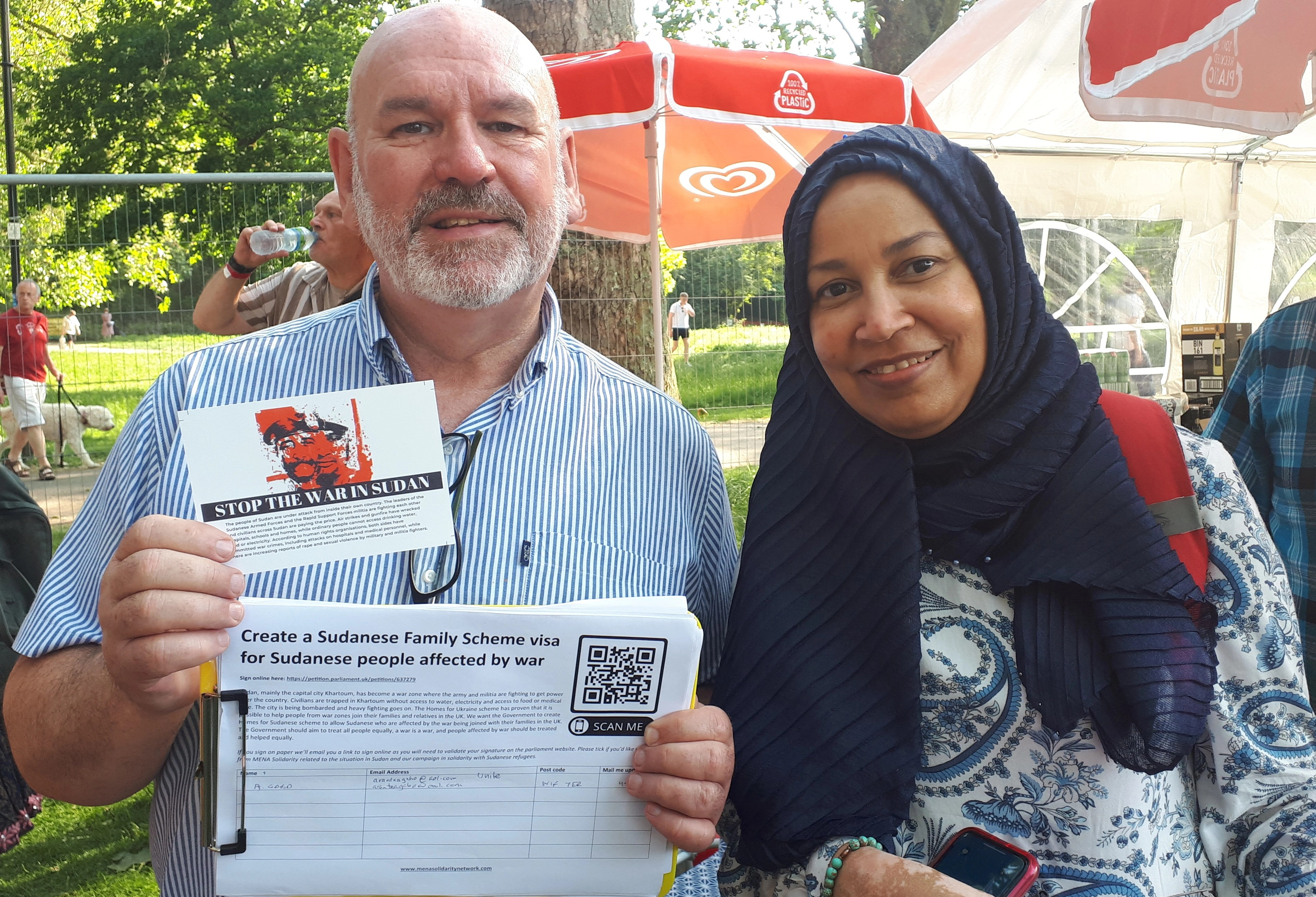
Refugee campaigners and Sudanese activists are backing a parliamentary petition calling on the government to create a Family Visa Scheme for Sudan. The petition has wide support with nearly 30,000 signatories and backing from trade union leaders like ASLEF’s Mick Whelan and MPs including Jeremy Corbyn. The PCS union’s national conference also endorsed a call for the British government to show “the same generosity of spirit” to Sudanese refugees as those fleeing war in Ukraine.
What you can do
- Sign and share the petition: https://petition.parliament.uk/petitions/637279
- Come to the Sudan Solidarity Conference on 30 September to find out more
- Pass a resolution in your union branch supporting the conference and agreeing to circulate the petition to members
 MENA Solidarity Network