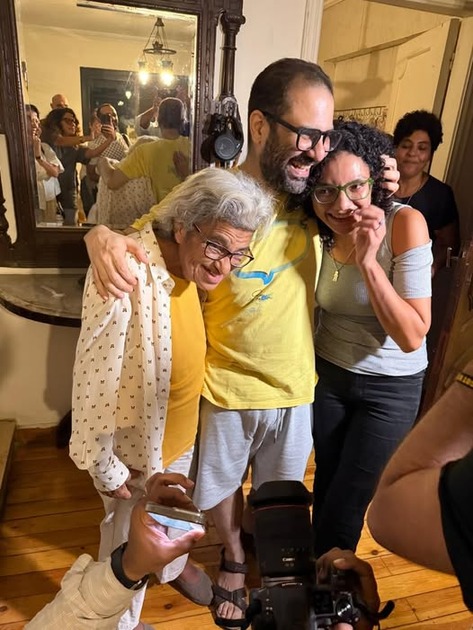
British-Egyptian writer and activist Alaa Abdel Fattah was released on Monday, 22 September 2025, by a presidential pardon. His release came one year late. He should have walked free in September 2024 after serving his unjust five-year sentence, but the regime refused to count the two years he had already spent in pretrial detention.
His freedom is the result of sustained struggle. Alaa’s 69-year-old mother, Laila Soueif, carried out a hunger strike for nearly 10 months demanding his release, putting her life at risk. She and his sisters, Mona and Sanaa, were attacked while staying outside Tora Prison on 22 June, and no justice has been served.
Alaa has been a target of the Egyptian state since the 2011 Revolution, when millions rose against Mubarak. For his role in those protests, he was jailed repeatedly. In 2015 he was sentenced to five years for demonstrating. When briefly released, he was arrested again in September 2019, held illegally in pretrial detention for over two years, and then sentenced in December 2021 to another five years for “spreading false news”. UN human rights experts said he was denied a fair trial at every stage.
Inside prison, Alaa faced harsh treatment. Human Rights Watch reported that he was beaten and abused in the Tora Prison Complex. Amnesty International confirmed that for years he was denied sunlight, fresh air, legal access, and visits.
MENA Solidarity has campaigned for Alaa’s release since 2011. From trade unions and conferences to protests and vigils outside St Thomas’ Hospital in London, collective pressure kept his case alive.
But thousands remain in prison. Even as Alaa walked free, the state struck again. On Wednesday, 24 September 2025, investigative journalist Ismail Alexandrani was arrested. Trade unionist Shady Mohamed and cartoonist Ashraf Omar are also still behind bars. The regime continues its policy of mass imprisonment to silence any challenge.
Sisi’s pardon is not an act of goodwill. It’s a constitutional right forced by international solidarity and fear of renewed revolt. The regime still rules by repression, trying to erase the spirit of 2011.
As trade unionists here in Britain, we cannot separate our struggles from those in Egypt. Our government arms and funds Sisi while cutting our services and attacking our rights. The same system that exploits workers here supports dictators abroad.
That is why solidarity is not charity – it is a shared fight. By linking up our unions with those in Egypt, by demanding an end to British support for Sisi, and by standing with every political prisoner, we strengthen both sides of the struggle.
Alaa is free. Thousands are not. The fight goes on.
 MENA Solidarity Network
Pingback: Egyptian state repression: Made in the West - Workers' Voice/La Voz de los Trabajadores
Pingback: Egyptian state repression: Made in the West - International Worker's LeagueInternational Worker's League